Articles
23.06.2026
Language education, AI and democracy
 In his opening keynote at the launch event of the Open Innovation Dialogue Hub in Strasbourg on 16 June 2026, Alain Berset, Secretary General of the Council of Europe, highlighted the essential role of languages in shaping inclusive and democratic societies: “Languages shape how we think, how we solve problems, and how we imagine the future. It is important to underline that diversity is one of Europe’s great strengths, particularly in today’s world.”
The Secretary General also underlined that linguistic diversity is not only a cultural issue, but a democratic one: in a Europe facing democratic backsliding, open debate cannot depend on one dominant language, and digital inclusion is a condition for democratic participation.
Aline Kunz, the member in respect of Switzerland on the Committee of Experts of the European Charter for Regional or Minority Languages, contributed as a panellist in a session dedicated to AI and linguistic sovereignty in Europe.
Through its current programme, Language Education at the Heart of Democracy, the European Centre for Modern Languages of the Council of Europe places language education at the core of democratic life, supporting approaches that foster plurilingual, inclusive and participatory learning environments across Europe
This vision is also reflected in the ECML project "AI for language education" (2024-27), which explores how artificial intelligence can be used critically, responsibly and purposefully in language teaching and learning. The project aims to help ensure that technology supports linguistic diversity, inclusion and participation.
The Open Innovation Dialogue Hub is jointly organised by the Microsoft Open Innovation Centre, the Council of Europe, and GitHub, convened European policymakers, researchers, and cultural institutions to explore the role of open innovation in advancing genuine digital digital sovereignty in Europe.
More information: ECRML news item "COMEX highlights the need for linguistic diversity at Open Innovation Dialogue Hub in Strasbourg"
Photo credit: MOIC Open Innovation Dialogue Hub: Opening - Alain Berset, Secretary General of the Council of Europe © Council of Europe, Strasbourg
03.02.2026
Strengthening digital participation and multilingualism - ECML presentation in German at DaFWEBKON 2026
In her presentation on 28 January at the online conference for teachers of German as a foreign language – DaFWEBKON 2026 –, Susanna Slivensky, Deputy Director and Head of programmes of the European Centre for Modern Languages of the Council of Europe, highlighted how the Centre links language education with digital citizenship and democratic culture. Framing language education as a core component of “Education for Democracy”, she explained that plurilingual and intercultural competences, together with critical digital skills, are essential for responsible participation in today’s societies. The ECML’s current programme, Language education at the heart of democracy, supports member states through research-based, practice-oriented projects that focus on teacher education and classroom implementation.
A central focus of the talk was the strong connection between plurilingualism and digital citizenship. According to ECML policy frameworks and Council of Europe recommendations, plurilingual and intercultural education not only strengthens communication and mediation skills, but also fosters ethical action, critical media use, inclusion, and awareness of rights and responsibilities online. Language classrooms are therefore seen as key spaces where learners can develop both democratic and digital competences in an integrated way.
Slivensky presented two major ECML resources: Digital Citizenship through Language Education (E-LANG Citizen) and the ICT-REV database of digital tools for language teaching. These platforms offer teaching guides, classroom tasks, searchable activity banks, and practical tutorials that help teachers integrate digital media, AI tools, and multilingual approaches into their lessons. All materials are openly accessible and designed to support educators in strengthening digital citizenship through language education.
DAFWEBKON Conference
Freely accessible ECML resources
06.12.2025
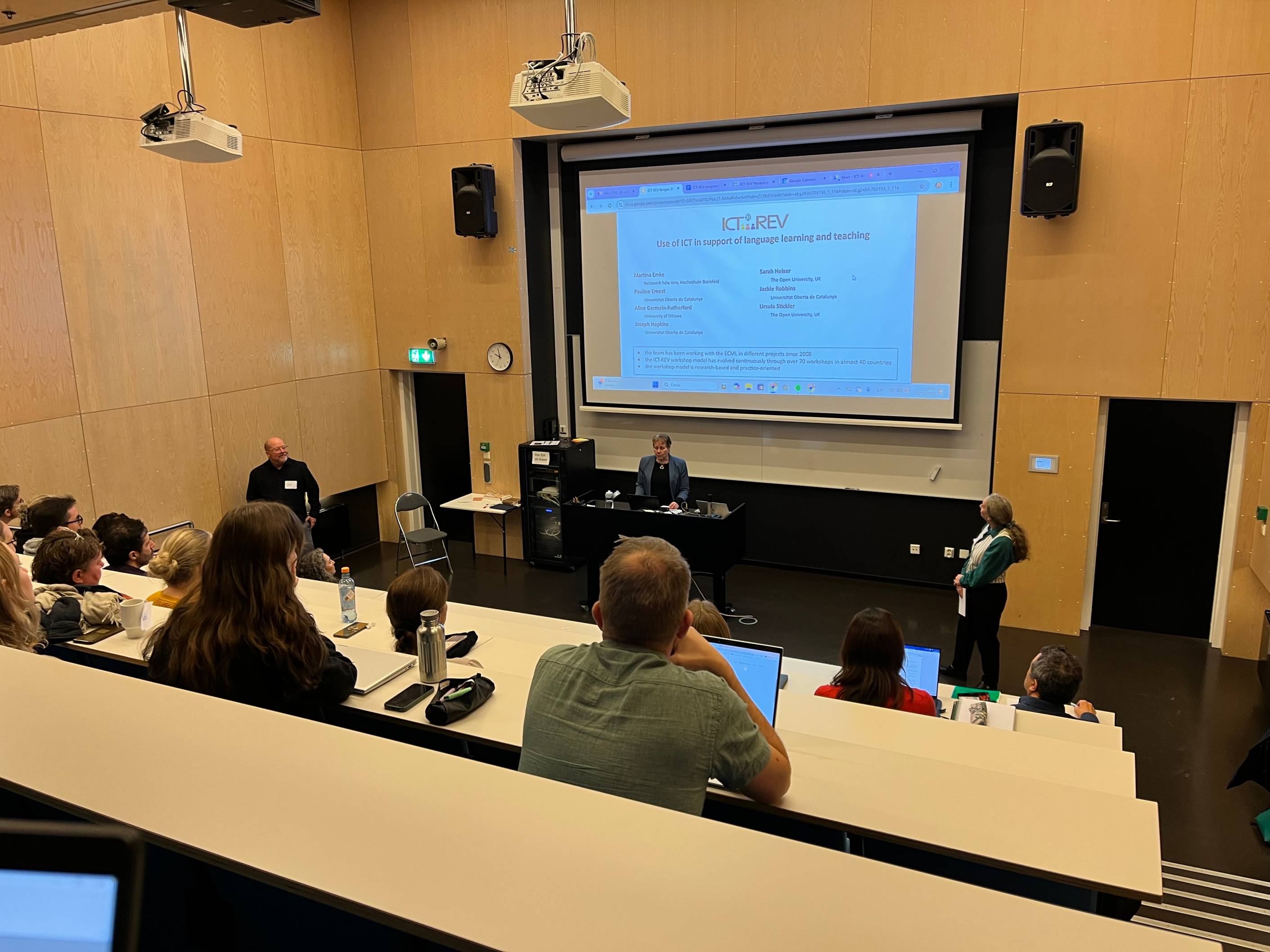
National Training Workshop “Using ICT in support of language teaching and learning (ICT-REV)” (20-21 November 2025, Bergen, Norway)
Empower Language Teaching with ICT and AI Competence
Norwegian schools are among the most digitalized in Europe, yet language teaching in English, French, German, and Spanish still faces a critical challenge: effectively integrating ICT tools into classroom practice. With rapid developments in artificial intelligence, this need has never been more urgent.
Teachers today must navigate new ways of organizing lessons and assessments while guiding students to critically evaluate the benefits and risks of AI. At the same time, societal debates around digital detox highlight the importance of purposeful, pedagogically sound use of technology in education.
The ICT-REV initiative by the European Centre for Modern Languages (ECML) offers practical solutions. Their resources and training, which took place in Bergen on 20 and 21 November, empowered 22 Norwegian teachers and teacher educators to:
- Design lesson plans that leverage ICT tools to achieve learning goals.
- Create assessment formats that reflect students’ use of AI responsibly.
- Foster digital literacy and critical thinking in language learning.
At the workshop, participants explored innovative strategies, accessed hands-on tools, and became part of a European network committed to quality teaching in the digital age.
Discover more and start transforming your classroom today: https://ict-rev.ecml.at/en/
Norwegian version (bokmål):
Styrk språkopplæringen med kompetanse i IKT og KI
Norske skoler er blant de mest digitaliserte i Europa, men språkopplæring i engelsk, fransk, tysk og spansk står fortsatt overfor en viktig utfordring: å integrere IKT-verktøy effektivt i undervisningen. Med raske utviklinger innen kunstig intelligens har dette behovet aldri vært mer presserende.
Lærere må i dag finne nye måter å organisere undervisning og vurdering på, samtidig som de veileder elever til kritisk å vurdere fordeler og ulemper ved KI. Samtidig peker samfunnsdebatten om «digital detox» på hvor viktig det er med målrettet og pedagogisk forsvarlig bruk av teknologi i skolen.
ICT-REV-initiativet fra Det europeiske senteret for moderne språk (ECML) tilbyr praktiske løsninger. Ressursene og opplæringen deres gir lærere og lærerutdannere kompetanse til å:
- Utforme undervisningsopplegg som bruker IKT-verktøy for å nå læringsmål.
- Lage vurderingsformer som tar hensyn til elevenes bruk av KI på en ansvarlig måte.
- Fremme digital kompetanse og kritisk tenkning i språkopplæringen.
Bli med og form fremtiden for språkopplæring. Utforsk innovative strategier, få tilgang til praktiske verktøy, og bli en del av et europeisk nettverk for kvalitetsundervisning i den digitale tidsalderen.
Les mer og start endringen i klasserommet i dag: https://ict-rev.ecml.at/en/
Deirdre Smith, local coordinator