News
06.03.2026
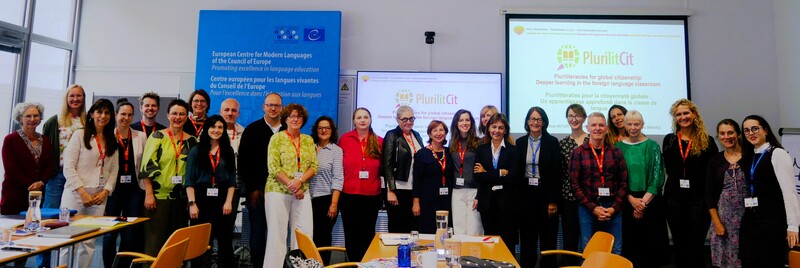
Graz meeting (26-27 February 2026): a major step forward for implementing “Pluriliteracies for global citizenship” through the 4Rs
The ECML “Pluriliteracies for global citizenship” team met in Graz on 26-27 February 2026 and made significant progress on the practical classroom implementation of the 4Rs Framework (Reading across plurimodal and multilingual texts; Repositioning through multiperspectival inquiry; Reflecting via epistemic humility and compassionate understanding; and Responding through ethically grounded participation and action).
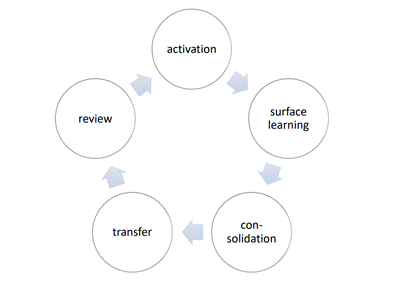
A key outcome was a complete set of tools that make the framework easier to plan with and teach from. The team finalised the alignment between the phases of a Deeper Learning Episode (activation, surface, consolidation, transfer) and the 4Rs, and agreed the guiding questions that support lesson planning, progression, and transfer. These resources will be presented and developed further with participants at the ECML workshop on 19-20 May 2026. The agenda for the May workshop was also finalised.
Crucially, working descriptor bands for all four Rs are now in place from A1 to C1, offering a clear progression pathway for deeper learning in the language(s) classroom. Just as importantly, the team strengthened the conceptual groundwork that makes these descriptors reliable in practice: shared definitions of reflection, critical (premise) reflection, reflexivity, and epistemic cognition are now agreed. This is critical for implementation because cognitive empathy – walking in somebody else’s problem – does not automatically lead to compassionate engagement. The missing link is reflexivity: noticing why we perceive, think, feel, or act as we do, and questioning the assumptions that quietly steer us. This deeper step helps learners reframe a problem and redirect action – turning empathy into compassion, and compassion into civic participation.
Authors: PlurilitCit team
Phases of a Deeper Learning Episode
- ECML project website “Pluriliteracies for global citizenship – Deeper learning in the foreign language classroom” (2024-2027): www.ecml.at/deeperlearning
26.11.2025
Pluriliteracies for global citizenship: Introducing the 4Rs Framework to design deeper learning episodes for the languages classroom
At the recent ECML project network meeting in Graz, the team introduced a new layer of the Pluriliteracies for Global Citizenship approach — the 4Rs Framework: Reading, Repositioning, Reflecting, and Responding.
Building on the theoretical foundations of Beyond CLIL, the 4Rs Framework translates pluriliteracies principles into concrete classroom design. Each “R” represents a distinct literacy practice:
- Reading across multilingual and plurimodal texts;
- Repositioning through multiperspectival inquiry;
- Reflecting with epistemic humility and empathy;
- Responding through dialogue and responsible action.
Together, these practices form spirals of deeper learning, enabling language learners to connect conceptual, linguistic, and citizenship growth.
To make the framework teachable and observable, the project introduced three complementary tools:
- Deeper Learning Episodes (DLEs) – design units that structure progression from activation to transfer;
- Ten Principles of Task Fidelity – guidelines for ensuring relevance, scaffolding, and feedback;
- Revised Guiding Questions for Teachers and Learners – prompts that translate design principles into classroom dialogue.
Alongside these tools, the team also presented a first version of descriptor bands for each of the 4Rs. The team will be assisted by world-renowned expert Prof. Francisco Lorenzo who presented the first research results conducted within the COST-project CLIL Network for Languages in Education: Towards bi- and multilingual disciplinary literacies (CLILNetLE).
These descriptors provide a formative assessment tool for observing and supporting learners’ development of pluriliteracies in the languages classroom, helping teachers trace progression and give feedback across Reading, Repositioning, Reflecting, and Responding.
Participants provided constructive and highly valuable feedback and input, helping the team fine-tune both the framework and its tools so that they better reflect diverse teaching contexts.
By linking theory and practice, the 4Rs Framework supports teachers in breaking down classroom walls — connecting learning with global and local realities and affirming the languages classroom as a space where global citizenship is not only discussed but practised.
Authors: PlurlitCit team
30.10.2024
Fostering global citizenship through pluriliteracies: Insights and reflections from the ECML network meeting
On September 17-18, the ECML in Graz hosted the first network meeting of the project “Pluriliteracies for global citizenship: Deeper learning in the foreign language classroom”. Twenty participants from 16 countries, including teachers, teacher educators, and university professionals, came together to explore key concepts and collaborative strategies aimed at enhancing global citizenship through pluriliteracies.
The meeting kicked off with a project overview, led by the project team, who introduced the main objectives and concepts of the initiative. Inspiring plenary sessions were delivered by experts Do Coyle and Christina Pylonitis, sparking insightful discussions among attendees. Participants engaged in meaningful dialogue in an open and collaborative atmosphere, reflecting on how the pluriliteracies approach can transform language education.
Central to the discussions was the 4R model, which provided a framework for rethinking language teaching and learning. Special emphasis was placed on the role of multimodality, multi-source reading, and integrating diverse perspectives to better address the realities of today’s classrooms.
The two-day event concluded with a draft list of key messages for educators and the establishment of a growing professional community, setting the stage for continued collaboration and action in advancing the goals of pluriliteracies and deeper learning in language education.
Merilin Aruvee, Silvia Minardi, Kathrin Jonas Lambert