News
16.04.2026
Workshop draws dozens to Graz to shape the future of plurilingual wellbeing
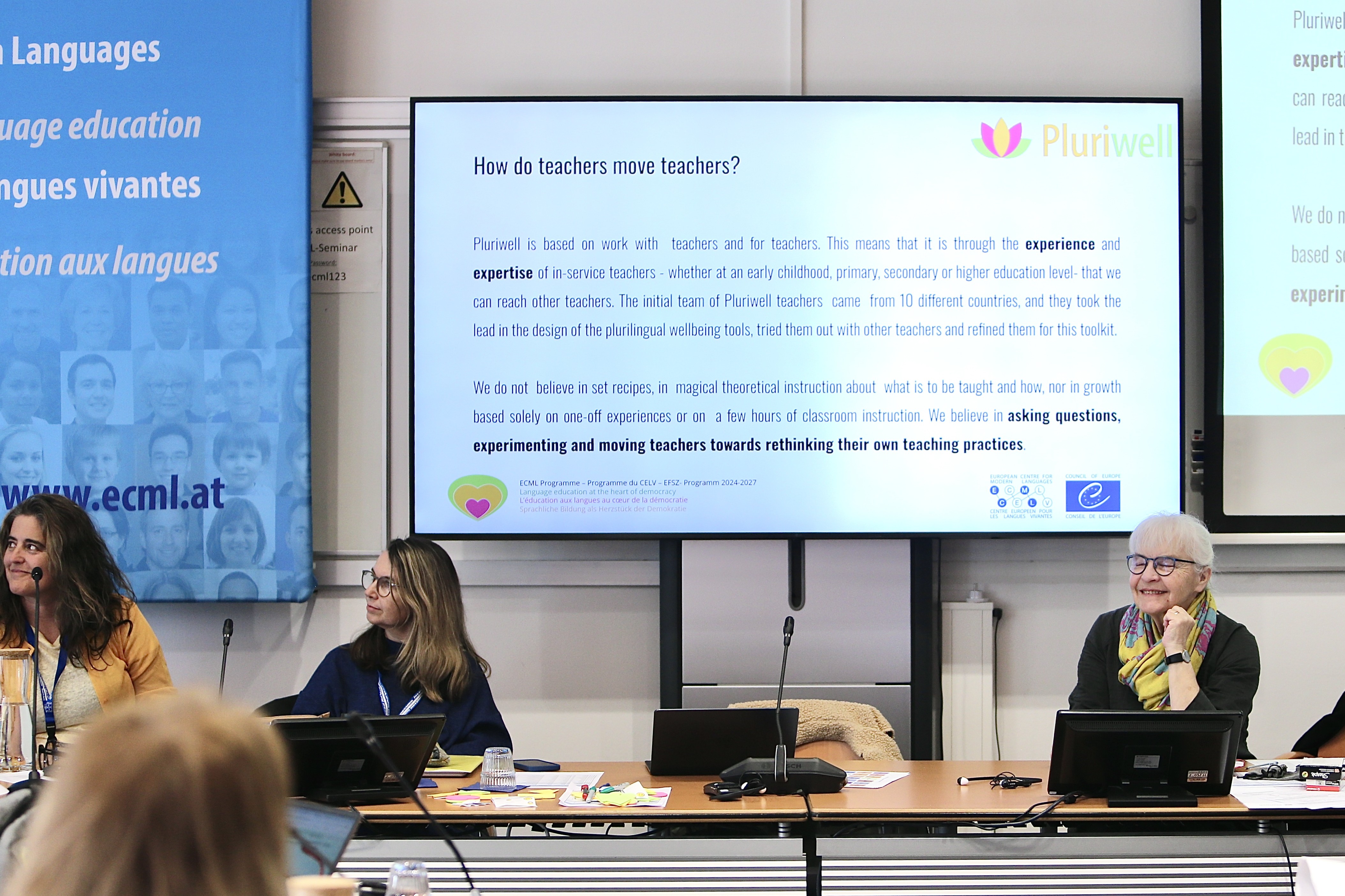 On March 25 and 26, the European Centre for Modern Languages played host to teachers, researchers and experts from around Europe for the Pluriwell workshop on “Fostering the plurilingual wellbeing of language teachers”. The event in Graz marked the culmination of more than two years of work on the Pluriwell project.
The sessions were attended by participants from 28 different Council of Europe member states, including working teachers, policymakers and university-based teacher educators. The workshop offered a chance for this diverse group of attendees to get their first look at the tools in the new Pluriwell toolkit. “Being able to try out our tools with such a diverse knowledgeable group of colleagues was immeasurably beneficial", said Pluriwell second language documentalist Gerit Jaritz.
Indeed, the participants brought with them a wide range of perspectives from very different language teaching and learning contexts. Emmanuel Julien, a French and Spanish teacher based in Andorra, observed that the plurilingual wellbeing tools could be of special interest to teachers in “reception” classrooms for migrant students. “With these students, who come primarily from South America, Ukraine, and the Philippines, the teachers, who are at least bilingual, use plurilingualism to break the ice, avoid language barriers, and facilitate a quick and positive integration into their new environment", he said.
One theme that emerged during the workshop discussions was the importance of recognizing the relationship between teacher and student wellbeing and how this can contribute to learning. As Frank Hansen, head teacher at Aarhus Kommune in Denmark noted, “There is a clear connection between teacher well-being and student well-being… It is important that we have an eye for and qualify the connection between multilingualism and wellbeing not only among students, but also among teachers. This is the core and great relevance of the Pluriwell project.”
Dolors Masats, a professor of language didactics at the Universitat Autònoma de Barcelona, is also a collaborator in the ECML project "A toolkit for implementing integrated didactics in language education", and she highlighted the relevance of plurilingual wellbeing to her own project. “[Participating] in a workshop entirely centred on the concept of teachers’ well-being raised my awareness of its key role in plurilingual education and of the need to explicitly refer to this perspective.” Masats highlighted the fact that “some Pluriwell techniques focus on helping teachers become aware of their own linguistic repertoires as a first step towards recognising those of their learners". She plans to incorporate parts of the Pluriwell approach into the materials selected for the Integrated Didactics Toolkit that is being created in the context of her ECML project.
The debates and discussions at the workshop provided valuable insights that will be incorporated into the final outcomes of the Pluriwell project. “The participants’ feedback on the toolkit will help us improve and refine the tools before they are published", said project coordinator Caterina Sugranyes. The attendees also contributed ideas that will help shape the forthcoming Pluriwell website. “The new website is expected to offer structured, user-friendly resources, while also supporting awareness and shared practice among teachers and teacher educators", said Chang Zhang, a web expert who attended the event from Ireland.
Incorporating a plurality of perspectives and contributions has been the norm for the Pluriwell project throughout. “Relationships and rapport are at the heart of wellbeing", Sugranyes said. “And they are also at the heart of this project, which has been a collective effort of the team, the participating teachers, the ECML, and now the workshop attendees. We are so grateful to all of them. Without them, this project would not have made sense to us, and we would not have been able to accomplish what we have done.”
Authors: ECML Pluriwell team
10.04.2026
Plurilingual wellbeing at the heart of democratic education: ECML Pluriwell project workshop
 The two-day workshop “Fostering the plurilingual wellbeing of language teachers”, held on 25-26 March 2026 at the European Centre for Modern Languages (ECML) in Graz, marked an important step in the development of the Pluriwell project (2024-2026).
Teachers’ wellbeing is increasingly recognised as a key factor in shaping high-quality, inclusive education. Within the Council of Europe’s broader commitment to democratic culture and education, teachers play a central role – not only as educators of their subjects, but also as professionals navigating linguistic diversity, cultural complexity and evolving learning environments. Supporting teachers in reflecting on their own language repertoires and identities is therefore essential.
The Pluriwell project addresses this by focusing on the concept of plurilingual wellbeing. How is this concept defined? It is not only being aware of and valuing the potential of one’s own language repertoire; it is also feeling comfortable with using this repertoire in a variety of personal and professional contexts. As the project coordinator, Caterina Sugranyes, explains, “much of the focus has always been on what we can’t do – plurilingual wellbeing shifts the focus to what we can do.” This dimension of wellbeing underpins teachers’ ability to foster plurilingual, intercultural and democratic competences in the classroom. Caterina Sugranyes also highlights that plurilingual wellbeing is closely linked to democratic culture, involving “positive emotions, openness to the world and relationships” – key elements for learning and living together in diverse societies.
The Graz workshop brought together 37 participants – including the expert team, consultant and partners – from 28 Council of Europe member states. As part of the four-year programme Language Education at the Heart of Democracy, the workshop provided a space for testing and refining the Pluriwell toolkit and for reviewing other project outputs, including guiding principles and teacher testimonials. The insights gathered will now feed into the finalisation of the project results, including the future Pluriwell website, making the outputs more widely applicable across different European educational contexts.
The ECML workshop reaffirmed the importance of placing teacher wellbeing – particularly in its plurilingual dimension – at the heart of efforts to strengthen education systems, support professional practice, and promote democratic culture through language education. This was echoed in the words of the project consultant, Chantal Muller, “When our languages – and, by extension, our identities – are valued, we feel recognised and respected for who we are. This recognition enhances teachers’ sense of wellbeing and enthusiasm, which in turn positively influences their teaching practices and interactions.”
26.11.2025
Pluriliteracies for global citizenship: Introducing the 4Rs Framework to design deeper learning episodes for the languages classroom
At the recent ECML project network meeting in Graz, the team introduced a new layer of the Pluriliteracies for Global Citizenship approach — the 4Rs Framework: Reading, Repositioning, Reflecting, and Responding.
Building on the theoretical foundations of Beyond CLIL, the 4Rs Framework translates pluriliteracies principles into concrete classroom design. Each “R” represents a distinct literacy practice:
- Reading across multilingual and plurimodal texts;
- Repositioning through multiperspectival inquiry;
- Reflecting with epistemic humility and empathy;
- Responding through dialogue and responsible action.
Together, these practices form spirals of deeper learning, enabling language learners to connect conceptual, linguistic, and citizenship growth.
To make the framework teachable and observable, the project introduced three complementary tools:
- Deeper Learning Episodes (DLEs) – design units that structure progression from activation to transfer;
- Ten Principles of Task Fidelity – guidelines for ensuring relevance, scaffolding, and feedback;
- Revised Guiding Questions for Teachers and Learners – prompts that translate design principles into classroom dialogue.
Alongside these tools, the team also presented a first version of descriptor bands for each of the 4Rs. The team will be assisted by world-renowned expert Prof. Francisco Lorenzo who presented the first research results conducted within the COST-project CLIL Network for Languages in Education: Towards bi- and multilingual disciplinary literacies (CLILNetLE).
These descriptors provide a formative assessment tool for observing and supporting learners’ development of pluriliteracies in the languages classroom, helping teachers trace progression and give feedback across Reading, Repositioning, Reflecting, and Responding.
Participants provided constructive and highly valuable feedback and input, helping the team fine-tune both the framework and its tools so that they better reflect diverse teaching contexts.
By linking theory and practice, the 4Rs Framework supports teachers in breaking down classroom walls — connecting learning with global and local realities and affirming the languages classroom as a space where global citizenship is not only discussed but practised.
Authors: PlurlitCit team