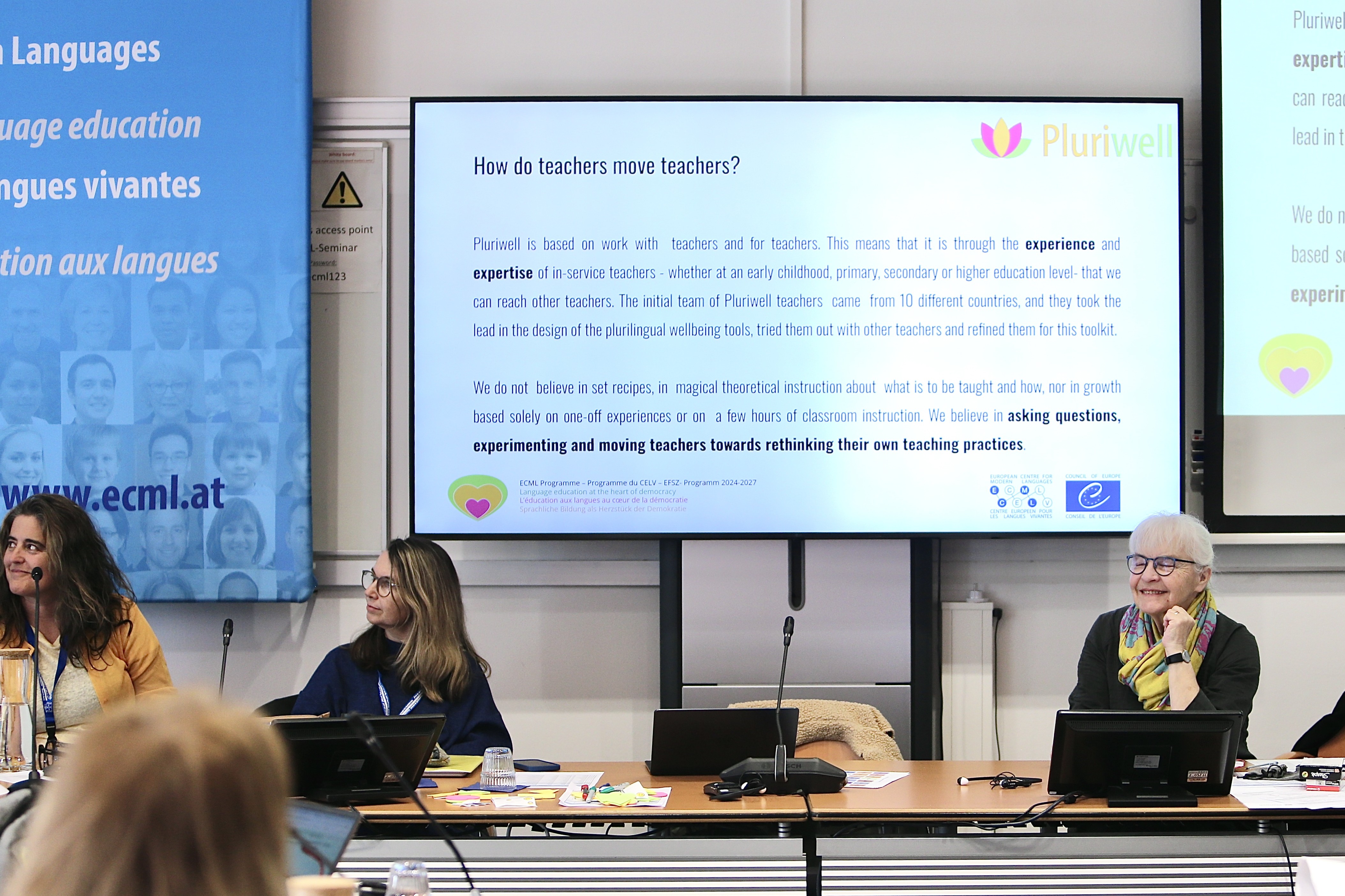
 On March 25 and 26, the European Centre for Modern Languages played host to teachers, researchers and experts from around Europe for the Pluriwell workshop on “Fostering the plurilingual wellbeing of language teachers”. The event in Graz marked the culmination of more than two years of work on the Pluriwell project.
The sessions were attended by participants from 28 different Council of Europe member states, including working teachers, policymakers and university-based teacher educators. The workshop offered a chance for this diverse group of attendees to get their first look at the tools in the new Pluriwell toolkit. “Being able to try out our tools with such a diverse knowledgeable group of colleagues was immeasurably beneficial", said Pluriwell second language documentalist Gerit Jaritz.
Indeed, the participants brought with them a wide range of perspectives from very different language teaching and learning contexts. Emmanuel Julien, a French and Spanish teacher based in Andorra, observed that the plurilingual wellbeing tools could be of special interest to teachers in “reception” classrooms for migrant students. “With these students, who come primarily from South America, Ukraine, and the Philippines, the teachers, who are at least bilingual, use plurilingualism to break the ice, avoid language barriers, and facilitate a quick and positive integration into their new environment", he said.
One theme that emerged during the workshop discussions was the importance of recognizing the relationship between teacher and student wellbeing and how this can contribute to learning. As Frank Hansen, head teacher at Aarhus Kommune in Denmark noted, “There is a clear connection between teacher well-being and student well-being… It is important that we have an eye for and qualify the connection between multilingualism and wellbeing not only among students, but also among teachers. This is the core and great relevance of the Pluriwell project.”
Dolors Masats, a professor of language didactics at the Universitat Autònoma de Barcelona, is also a collaborator in the ECML project "A toolkit for implementing integrated didactics in language education", and she highlighted the relevance of plurilingual wellbeing to her own project. “[Participating] in a workshop entirely centred on the concept of teachers’ well-being raised my awareness of its key role in plurilingual education and of the need to explicitly refer to this perspective.” Masats highlighted the fact that “some Pluriwell techniques focus on helping teachers become aware of their own linguistic repertoires as a first step towards recognising those of their learners". She plans to incorporate parts of the Pluriwell approach into the materials selected for the Integrated Didactics Toolkit that is being created in the context of her ECML project.
The debates and discussions at the workshop provided valuable insights that will be incorporated into the final outcomes of the Pluriwell project. “The participants’ feedback on the toolkit will help us improve and refine the tools before they are published", said project coordinator Caterina Sugranyes. The attendees also contributed ideas that will help shape the forthcoming Pluriwell website. “The new website is expected to offer structured, user-friendly resources, while also supporting awareness and shared practice among teachers and teacher educators", said Chang Zhang, a web expert who attended the event from Ireland.
Incorporating a plurality of perspectives and contributions has been the norm for the Pluriwell project throughout. “Relationships and rapport are at the heart of wellbeing", Sugranyes said. “And they are also at the heart of this project, which has been a collective effort of the team, the participating teachers, the ECML, and now the workshop attendees. We are so grateful to all of them. Without them, this project would not have made sense to us, and we would not have been able to accomplish what we have done.”
Authors: ECML Pluriwell team