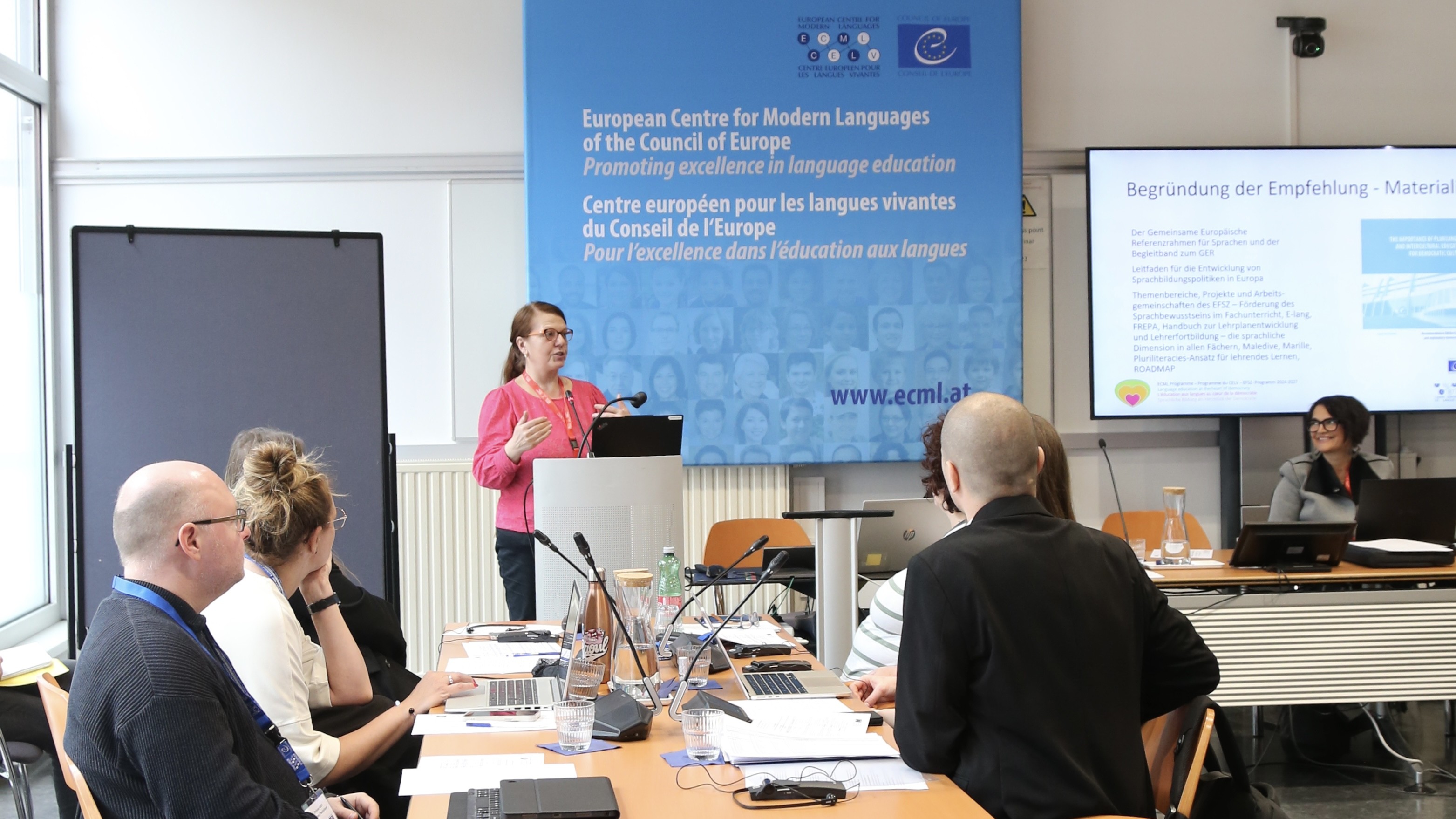
 From 14–15 April 2026, the European Centre for Modern Languages (ECML) of the Council of Europe in Graz held a workshop for the project, “Using ECML resources to support plurilingual and intercultural education for democratic culture” (ARPIDE). Bringing together 29 participants from 25 countries, the event marked a key milestone in the ARPIDE project (2024–2026), which is part of the ECML’s four-year programme, Language Education at the Heart of Democracy. The workshop focused on using ECML resources to bridge the gap between policy and classroom practice in plurilingual and intercultural education.
Central to the ARPIDE project is Recommendation CM/Rec(2022)1 on the importance of plurilingual and intercultural education for democratic culture. This Recommendation, adopted by the Committee of Ministers of the Council of Europe, highlights the key role of language education in fostering democratic values, inclusion, and social cohesion. It encourages member states to ensure that language learning at all education stages helps develop plurilingual and intercultural competences. ARPIDE supports the implementation of this Recommendation by encouraging educators to draw on ECML resources to put its ambitious policy framework into practice.
Over the course of two days, participants explored the ARPIDE pathway – a practical process for identifying, evaluating, and adapting ECML resources for varied educational settings. Activities included group work, peer feedback, and hands-on sessions with innovative tools such as the ARPI chatbot, which helps users navigate the ECML website in order to select suitable resources in an interactive way. The workshop brought together professionals from a range of countries and backgrounds, providing perspectives that will help ensure the ARPIDE outputs are both relevant and adaptable across contexts.
The necessity of the ARPIDE project became particularly evident during the workshop. As project coordinator Kenia Puig remarked, ARPIDE shows how the Recommendation can be brought to life in real classroom practice. The workshop made clear the value of connecting top-down policy – such as national strategies and frameworks – with bottom-up innovation, reflecting the practical ideas and experience of educators on the ground. This combination is essential for translating the Recommendation into everyday educational practice.
ARPIDE’s focus on the use of ECML resources in the classroom complements recent developments within the Council of Europe’s Language Policy Programme and the launch of the Reflection and Planning Survey Tool for lower-secondary. This strategic self-assessment instrument is grounded in the same Recommendation and helps member states review and strengthen their language education systems with a view to promoting plurilingual and intercultural education for democratic societies. A Policy Toolbox directs decisionmakers and teacher educators to key Council of Europe resources.
As the ARPIDE project moves towards its final outputs – the ARPIDE pathway to use and adapt ECML resources, a chatbot to identify relevant resources and illustrations of ECML resources in practice – it is helping to advance plurilingual and intercultural education as a key level for strengthening our plural democracies.
- ECML project website “Using ECML resources for plurilingual and intercultural education for democratic culture” (2024-26) (available in English and German): www.ecml.at/arpide